

There’s a pitch making the rounds in hotel boardrooms right now, and it sounds almost too good to be true. “Ditch the OTAs. Join our brand. Save 6 to 8 percent on commissions.” It’s clean. It’s compelling. And for overworked revenue managers exhausted by paying Expedia or Booking.com nearly a fifth of every reservation, it feels like salvation.
But before you sign that franchise agreement, it’s worth looking much harder at the math. Because what looks like a discount is often something else entirely a distribution illusion.
The pitch vs. the reality
The story goes like this: you’re currently paying around 18% to an OTA per booking. That’s painful, visible, and hard to ignore every time the monthly statement arrives. The brand alternative quotes you 11 to 15%. That’s a saving of at least 3 percentage points, right?
Not quite. The brand’s 11–15% is not a single, simple commission. It’s a bundle of fees stacked on top of each other and they apply to all your bookings, not just the ones generated through brand channels.
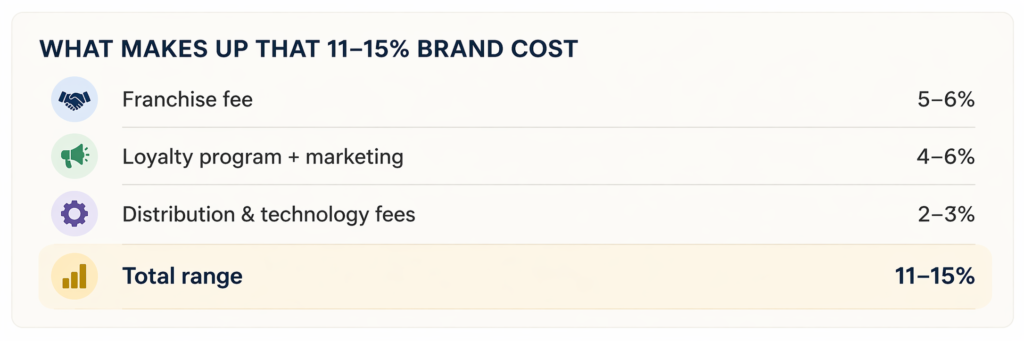
Now compare that to the OTA model, which charges you only when it delivers a booking. The brand model charges you regardless. That distinction matters enormously when you start running actual numbers.
The $200 reservation test
Let’s make this concrete. Imagine you sell a $200 room reservation. Here’s what each model actually costs you:
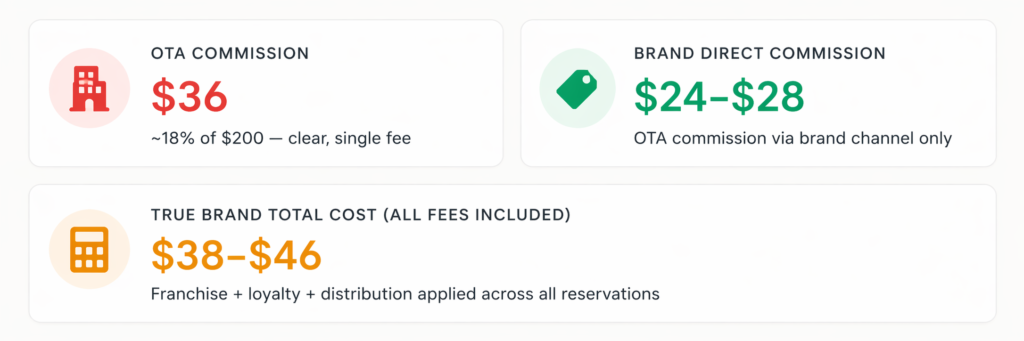
Your OTA direct cost goes down. Your total cost of distribution goes up. This is the core of the distribution illusion: the visible line item improves while the real number quietly gets worse.
The math gets worse if you’re already selling direct
“If those bookings were already direct, you’re switching from a $5–10 channel to a $22–30 channel.”
Strong independent hotels often achieve 40 to 60 percent direct booking rates. If your property is already at that level, you’re paying very little per booking on the direct share perhaps $5 to $10 in transaction and technology costs. When you affiliate with a brand and their fees apply universally, those previously low-cost direct bookings suddenly carry the full 11–15% burden.
The arithmetic is startling. For bookings that were already direct already yours your average cost of distribution can increase by three times after joining a brand. You’re paying $17 to $25 more per reservation to acquire a guest you would have acquired anyway.
When does the brand math actually work?
To be fair, there are scenarios where brand affiliation justifies its cost. If the brand is generating genuinely new demand bringing guests to your property who would never have found you otherwise then you’ve paid for demand creation. That’s a legitimate value exchange, and the fees reflect real marketing work on your behalf.
The question every owner must answer honestly is: how much of the brand’s projected volume is truly incremental demand, and how much of it is simply repackaging the guests you were already going to win?
- If 80% of projected brand bookings would have come through your existing channels anyway, the model destroys margin.
- If the brand opens up genuinely new customer segments international travelers, loyalty members who wouldn’t search independently there’s a case to be made.
- If your direct booking rate is already above 40%, the breakeven point is very hard to reach.
What strong independent hotels should ask before deciding
Before entering any brand or soft-brand arrangement, revenue leaders should model the total cost of distribution, not just the headline commission rate. That means accounting for franchise fees, loyalty costs, technology fees, and how those charges apply across your entire booking mix not just brand-sourced reservations.
“Key question to stress-test: “If I apply brand fees to my current direct and OTA mix at today’s volume, what does my total cost of distribution become — and how does that compare to what I’m paying today?”
The answer is often uncomfortable. Hotels with strong direct booking engines, loyal local demand, and competitive independent positioning frequently find that OTA costs painful as they are represent a performance-based model that only triggers when a booking is actually delivered. The brand model, by contrast, charges a tax on every reservation regardless of its origin.
The bottom line
Saving on OTA commissions is a legitimate goal. But the route to achieving it is not necessarily through brand affiliation it’s through investing in direct booking capabilities, loyalty programs you own, and guest relationships that don’t require a third party to intermediate.
The distribution illusion is seductive precisely because it replaces one visible cost with a smaller visible cost, while hiding the full accounting behind franchise agreements and loyalty surcharges. Smart operators look at the total number. And when they do, the case for giving your guests to a brand and paying for it rarely holds up.