


Ask any hotel owner what they’d change about their business tomorrow, and the answer is almost always the same: fewer OTA bookings, more direct ones. It’s one of the most universally understood goals in hospitality. Yet most properties still generate 50 to 70 percent of their reservations through third-party channels paying commissions that quietly erode profitability year after year.
The reason isn’t a lack of desire. It’s a lack of clarity on exactly how direct bookings improve the bottom line, and what it actually takes to shift the mix. This post breaks both down.
The real cost difference booking by booking
The most immediate impact of a direct booking is straightforward: you don’t pay a commission to a third party. But the full picture is richer than that. A $200 reservation tells the story clearly:
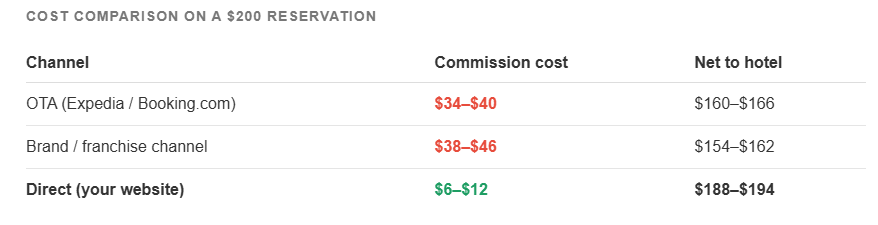
Direct channel costs aren’t zero you’ll have booking engine fees, payment processing, and modest technology overhead. But they’re performance-agnostic and dramatically lower. On a 100-room hotel running 70% occupancy, shifting just 10 percentage points of bookings from OTA to direct can recover $150,000 to $250,000 in annual margin, depending on ADR.
Beyond the commission: why direct guests are worth more
“An OTA guest belongs to the OTA. A direct guest belongs to you.”
This is the insight that changes how serious revenue managers think about distribution. When a guest books through Booking.com or Expedia, the platform owns the relationship. They hold the email address, the behavioral data, the future retargeting opportunity. You receive an occupancy statistic and a net rate.
When that same guest books directly, you own everything. You know who they are, what they prefer, when they travel, and what they spend. You can email them before arrival, upsell a room upgrade, offer a loyalty incentive, and invite them back with a reason to return — all without paying another commission to do it.
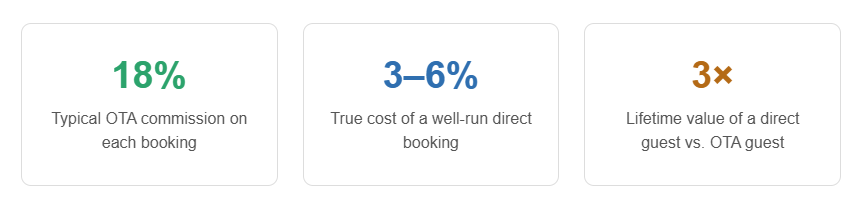
The lifetime value gap between a direct guest and an OTA-sourced guest is substantial. Research consistently shows that guests who first book direct return at higher rates, spend more on property, and cost far less to re-acquire than OTA guests, who are effectively re-rented to you at full commission each visit.
The profitability compounding effect
Direct booking profitability isn’t linear — it compounds. Here’s how that works in practice:
First stay: commission saved
You capture the full margin on the initial reservation instead of surrendering 15–20% to a platform.
The savings are immediate and real.
Post-stay: data captured
You now hold a verified guest profile. Email, preferences, spend behavior. This costs nothing to maintain
and appreciates in value over time.
Return stay: near-zero acquisition cost
A targeted email to a past direct guest costs pennies. A re-acquisition through an OTA costs the same
18% commission as the first time. The margin difference on repeat visits is extraordinary.
Advocacy: organic referrals
Direct guests who feel a genuine connection to your property refer others — word-of-mouth and review
behavior that OTA guests rarely replicate at the same rate.
Reduced OTA dependency: pricing power restored
As direct volume grows, your reliance on OTA rate parity rules weakens. You gain the ability to reward
loyal guests with exclusive rates without broadcasting those rates to platforms that will undercut your positioning.
What it actually takes to shift the mix
Knowing the value of direct bookings is not the same as capturing them. Hotels that successfully move the needle share a common set of practices:
A booking engine that converts. Most hotel websites lose potential direct guests at the reservation step. Slow load times, confusing UI, and an inability to match the OTA experience in terms of rate transparency and flexibility are conversion killers. Your booking engine should be mobile-first, fee-transparent, and faster than any OTA comparison page.
A best rate guarantee that guests actually believe. The most common reason guests book through an OTA instead of direct is the perception often correct that they’ll find a better rate or more flexible cancellation terms on the platform. Prominently guaranteeing rate parity or better, with a visible match promise, removes that hesitation.
Direct-exclusive value. Rather than competing on price alone, strong independent hotels offer direct-bookers something OTAs cannot: early check-in priority, room upgrade eligibility, complimentary breakfast, or a welcome amenity. The perceived value of a $15 welcome drink far exceeds its cost, and it creates an emotional association with booking direct.
Email capture at every touchpoint. Front desk check-in, Wi-Fi login, restaurant reservations, spa bookings — every interaction is an opportunity to capture a verified email address. A database of 5,000 past guests who booked direct is a marketing asset worth more than any OTA listing.
Retargeting for OTA visitors. Many guests discover your property on an OTA, then research you independently before booking. Retargeting pixels on your website combined with a compelling direct booking incentive can intercept that decision at the moment it matters most, converting an OTA-sourced discovery into a direct reservation.
“The goal is not to eliminate OTAs overnight. They serve a real function for demand generation and new guest discovery. The goal is to graduate guests from OTA channels into a direct relationship and then keep them there.”
What the numbers look like at scale
Hotels that invest seriously in direct booking programs typically reach 40 to 60 percent direct mix within two to three years. At that level, the financial impact is transformative. Every percentage point of shift from OTA to direct recovers roughly $10 to $20 per reservation in net margin, depending on ADR. For a mid-size independent hotel doing 15,000 room nights per year, moving from 30% direct to 50% direct adds $300,000 to $600,000 to the bottom line without adding a single room or raising a rate.
That’s not marketing spend. That’s not revenue growth. That’s pure margin recovery from distribution efficiency.
The bottom line
Direct bookings improve profitability in three simultaneous ways: they lower acquisition cost immediately, they create guest data assets that reduce future acquisition cost, and they build a loyal segment that spends more, returns more often, and refers more guests. No OTA offers any of those three things. They offer demand at a price.
The hotels winning on direct bookings aren’t doing anything exotic. They’re investing in a better website, a smarter email program, a convincing rate guarantee, and a guest experience worth returning for. The economics reward that investment quickly and the compounding effect makes it one of the highest-return strategic priorities available to any independent property.